Showing posts with label SubContinentFocus. Show all posts

Friday, July 16, 2010

Have the India-Pakistan peace talks collapsed?

Have the India-Pakistan peace talks collapsed?

Are India and Pakistan back to square one as far as peace talks are concerned? Has the dialogue between South Asia's warring neighbours - which appeared to be limping back to some normalcy in the past six months - collapsed?


Triggering off this frenzied debate in India has been Pakistan Foreign Minister Shah Mehmood Qureshi's surprising outburst on Friday blaming India for the talks deadlock: "It seems India is not mentally prepared to engage in a dialogue," he said.

Mr Qureshi's feelings appear to have been provoked by familiar frustrations that have traditionally bedevilled ties between the two sides. Only this time, Pakistan appears to be complaining about India's inflexibility - meaning, among other things, a refusal to discuss thornier issues like Kashmir - impeding a fair dialogue. This is nothing new. India has always held Pakistan is obsessed with Kashmir; Pakistan says India cannot see beyond alleged Pakistani involvement in the 2008 Mumbai attacks.
What prompted Mr Qureshi's sudden broadside against India even as his Indian counterpart was getting ready to board the flight to Delhi? Many in Delhi say that the Pakistani establishment was seething after India's Home Secretary, GK Pillai, accused the Pakistani spy agency Inter-Services Intelligence of being involved in the Mumbai attacks on the eve of the talks. Some are already wondering whether the comments were deliberately aimed to derail the talks - Delhi's foreign policy pundits talks about hawks and doves in the government who are divided over the need for talks with Pakistan. On the other hand, most Indians believe that the Pakistani leadership is not doing enough to rein in militants launching attacks on India, and clerics indulging in hate campaigns against India.

What left most baffled was Mr Qureshi's personal attack on Mr Krishna, that he kept interrupting their meeting by taking calls from Delhi - something which many in India find a breach of diplomatic etiquette. Mr Krishna has denied the allegation.

But then nobody expected any dramatic breakthroughs in the Islamabad talks. The Indian media echoed the sentiment in their coverage today. One bland headline simply said: "India, Pakistan decide to remain engaged." That is how low expectations are in India about ties with its estranged sibling these days.
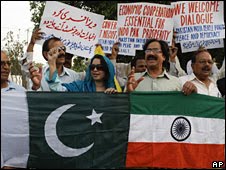
But browsing the Pakistani media, I came away with the impression that the frustration was higher on the other side of the border. The News, a Pakistan daily, lamented that the talks had "collapsed, not for the sheer absence of the right momentum, but because of India's inflexibility."


Clearly, Mr Qureshi's outburst will make it difficult for India to sell the talks to its people - a leader of the main opposition BJP, a Hindu nationalist party, has already demanded that talks be called off. But the two sides need to keep talking. Because when it comes to two nuclear-armed hostile neighbours, not talking can be more perilous for both. Pakistan's frustration with a stalemate should not surprise many. "Stalemate [between India and Pakistan] seems to be more attractive to each side that finding a solution," says Stephen Cohen, a regional specialist at the Brookings Institution, a US foreign policy think tank. The problem is that this prolonged, agonising stalemate hurts the people of both the countries, and ensures the region's future remains in jeopardy.

Tuesday, July 13, 2010

Al-Qaeda aims to cash in on Kashmir

Asian times online: Al-Qaeda aims to cash in on Kashmir

Pakistan-sponsored proxy operations that were largely abandoned several years ago have been revived at both the political level and on the armed insurgency front in Indian-administered Kashmir.


For al-Qaeda, watching from Pakistan's North Waziristan tribal area, this provides an opportunity for which it has waited a long time - to hijack Pakistan's "bleed India" operations for its own cause, that is, to pull India into the region's war theater.

The struggle for the right of self-determination in Indian-administered Kashmir, which died down following Pakistan's crackdown on Kashmiri militant groups under American pressure from 2002 onwards, has flared again.


Over the past four weeks, more than 15 people have died in clashes between the local Muslim Kashmiri population and police and paramilitary soldiers, mostly in Srinagar, the summer capital of the Indian state of Jammu and Kashmir. Last week, for the first time ever, the army was sent into Srinagar.

Sources who spoke to Asia Times Online say that two militant organizations - al-Badr led by Bakht Zameen Khan and the Lashkar-e-Taiba, whose resources were largely depleted up until 2008 - are involved in the unrest. They have sent people across the Line of Control that separates the Pakistan-administered and Indian-administered Kashmirs.

This marks the second Kashmiri intifada - the first began in 1989 and resulted in more than a decade of some of the worst violence South Asia has seen and on several occasions brought India and Pakistan to the point of war - fighting did break out briefly at Kargil in 1999.

Speaking to Asia Times Online, a senior Western diplomat commented, "A water dispute is the main bone of contention between the two countries. Although we have found that Pakistan's water problem is the result of internal mismanagement and has nothing to do with Indian intrigues as projected by Pakistan, jihadis are now exploiting the issue for recruitment and wrongfully projecting that if India is not controlled, the whole of Pakistan will be turned into a desert."

The dispute centers on the Neelum River that flows from Indian-administered Kashmir into Pakistan. Under pressure from the US to reduce tensions because their rivalry spills over into Afghanistan and complicates efforts to bring peace there, India and Pakistan are scheduled this week to discuss the appointment of a panel of neutral experts. They will consider India's plans to dam the river for a 330-megawatt hydro-electric power project.

Al-Qaeda watches on

By the standards of the long-running conflict in Kashmir, the latest flare-up is relatively low key, involving mostly street protests, in contrast to the bloody militant attacks of previous years.

For al-Qaeda, though, this is a big moment in terms of its Ghazwai-e-Hind, the Prophet Mohammad's promised end-of-time battle for the conquest of India.

Al-Qaeda decided to start its Ghazwa-e-Hind operations by claiming responsibility for an attack on February 13 this year in which a bomb exploded at the German Bakery in the city of Pune, Maharashtra state, killing 17 people and injuring at least 60.

However, at the 11th hour the decision was shelved and responsibility was claimed by a pseudo organization called Laskhar-e-Taiba al-Alami. Later, al-Qaeda leader Mustafa Abu al-Yazid (now killed) announced in a video message that the attack had been carried out by commander Ilyas Kashmiri's 313 Brigade, which is assigned for al-Qaeda's India operations. A few days after the Pune attack, Kashmiri sent an exclusive e-mail message to Asia Times Online warning that more attacks would be carried out in India. (See Al-Qaeda chief delivers a warning February 13, 2010.)

According to well-placed sources in al-Qaeda, al-Qaeda sees the unrest in Kashmir as a "god-gifted" opportunity to steal the Kashmiri insurgency from its Pakistani handlers and use it for its Ghazwa-e-Hind operations. These sources say the next operation will be in the Indian capital New Delhi in October during the Commonwealth Games.

"Al-Qaeda will take responsibility for these attacks and Dr Ayman al-Zawahiri [al-Qaeda's number two] will release a video message on the subject," one source said.
The networks of the Harkat-ul Jihad al-Islami (HuJI - Movement of Islamic Holy War) will provide logistical support. The al-Qaeda-linked HuJI's original mission was to set up Islamic rule in Bangladesh, but its ambitions and geographical spread now cover much of South Asia.

Inside India, according to the sources, the state of Uttar Pradesh will be al-Qaeda's rendezvous point. Here it will work with groups such as breakaway factions of the Students Islamic Movement of India (SIMI). SIMI was formed in the state in the late 1970s for the "liberation of India" from Western materialistic cultural influence and to convert the Muslim society to live according to Muslim codes of conduct.

Asia Times Online understands that al-Qaeda's aim is to start a pattern of terror attacks that will initiate a low-intensity insurgency in India's heartlands, including the Kashmir struggle, rather than stand-alone terror attacks.

In the bigger picture, according to the sources, the goal is to sabotage all US efforts to create peace in the region (especially Afghanistan) and draw India and Pakistan into a crisis situation.

Thursday, July 8, 2010

Curbs on media in Kashmir Valley

Curbs on media in Kashmir Valley

After seeking the Army's help to restore law and order, the Jammu and Kashmir government on Wednesday virtually banned the media in the Valley by imposing severe restrictions on journalists.


Authorities cancelled curfew passes issued to journalists and instructed the police and the CRPF not to allow any mediaperson to move around. Consequently, a number of journalists working for local, national and international organisations were not allowed to reach their offices.

PTI bureau chief in Srinagar A.M. Sofi was stopped by the CRPF in the Natipora area and asked to return home. “They told me that they had instructions from the top not to allow any journalist,” he said.

This reporter was not allowed to cross the Hyderpora bypass.

The police also clamped restrictions on the Press Enclave at Pratap Park, where most of the newspaper offices are located, asking the employees to stay indoors.

The cameras of some TV channels were seized. Cameras of NDTV and ANI were confiscated by the police on M.A. Road and newsmen of other channels were asked not to move out of their offices. “It is like marshal law,” one journalist said.

This is the first time that such restrictions have been put on the media.

District Magistrate of Srinagar Meraj Kakroo confirmed that all the curfew passes of journalists stood cancelled. “The Army is out so no curfew pass will be entertained,” he said.

No papers on Thursday
Newspaper owners have decided not to publish the papers on Thursday in view of the restrictions.

“How can we publish the paper when not a single person is allowed to move around,” Bashir Manzar, editor of English daily Kashmir Images, told TheHindu. He said such curbs were unheard of, that too in a democratically-elected set-up.

Monday, July 5, 2010

Bangladesh ferry sinks, about 12 missing

Bangladesh ferry sinks, about 12 missing

A ferry sank in Bangladhesh after being struck by a sand barge and about a dozen people were missing, police said, after earlier reports as many as 50 were unaccounted for.


No bodies had been found.

A police official earlier told reporters the ferry, carrying passengers across the river, had been rammed at Narayanganj, 20 km (12 miles) from Dhaka.

Ferry sinkings are common on Bangladesh rivers, killing hundreds of people every year, as operators overload vessels and flout safety regulations despite government pledges to ensure enforcement.

Tuesday, June 29, 2010

Maoists attack CRPF party in Chhattisgarh, 26 killed

Maoists attack CRPF party in Chhattisgarh, 26 jawans killed

Twenty six CRPF jawans have been killed and 23 injured in what is being seen as another major Naxal attack in Chhattisgarh.
Sources said at least 90 Maoists ambushed a 70-strong CRPF road-opening party in an area under Dhaurai police station in Narayanpur district of the state, at about 3 pm on Tuesday.

The CRPF men were securing the area ahead of a two-day Naxal-sponsored bandh starting tomorrow.

Reinforcements were on the way and IAF helicopters would be used to evacuate the injured and bring back the dead early on Wednesday morning, the sources said.

In the country's worst Maoist attack ever, at least 75 Central Reserve Police Force (CRPF) and a state police personnel were killed in an ambush on On April 6, in the thick Mukrana forests of Chhattisgarh's Dantewada district. (Read: 76 security men killed by Naxals in Chhattisgarh)

Pakistan president to visit China as nuclear deal advances

China said on Tuesday that it will host Pakistani President Asif Ali Zardari for top-level talks in early July, but would not say whether a controversial nuclear energy deal between the two nations will be discussed.
Zardari is a regular visitor to China, and his next trip from July 6 to 11 will include meetings with President Hu Jintao and Premier Wen Jiabao, Chinese Foreign Ministry spokesman Qin Gang told a regular news conference.


The announcement of the visit follows signs that China is moving forward with long-discussed plans to build two nuclear reactors at Pakistan's Chashma atomic complex, expanding a project that has worried Washington and India.

Two Chinese nuclear companies this month signed a contract to cooperate in construct the third and fourth plants at Chashma, building on China's rule at the complex in Punjab province. Pakistan faces severe power shortages.

Qin did not directly answer reporters' questions about whether the deal will be discussed during Zardari's visit.
"Both sides will exchange views on how to advance friendly cooperation in all areas, and also on international and regional issues of shared concern," said Qin.

Mounting indications that China will proceed with the reactor expansion in Pakistan, troubled by militant groups, have stirred international misgivings, especially in neighbouring India and the United States, who have their own nuclear energy deal.

The United States said this month it wanted clarification from China on the proposed plants.

Pakistan and India are rivals, and both possess nuclear weapons and stay outside the nuclear Non-Proliferation Treaty.

Islamabad has looked to Beijing to counter to Indian influence. In past decades, Chinese expertise was crucial to Pakistan's nuclear weapons programme, experts widely believe.

The proposed China-Pakistan nuclear energy deal was discussed last week by the Nuclear Suppliers Group, a body of 46 governments that seek to control access to their nuclear fuel and reactor technology to prevent the spread of atomic weapons.

The Chinese spokesman Qin said that any nuclear cooperation with Pakistan should not worry any other countries.

"Cooperation between China and Pakistan for the use of nuclear energy fully conforms with the international non-proliferation undertakings assumed by both countries and is entirely for peaceful purposes," he said.

Pakistan president to visit China as nuclear deal advances

Monday, June 28, 2010

South Asia facing severe terrorist problem: PC

Union Home Minister P Chidambaram has said the South Asian Region is facing severe terrorist problems, and urged all the nations for 'complete cooperation' in fighting the menace.


He was speaking at third SAARC (South Asian Association for Regional Cooperation) Interior/Home Ministers meeting recently held here.

"We can all undoubtedly agree that the South Asian region is faced with a serious security situation. The increasing threat of terrorism poses a major challenge to the maintenance of peace and security and adversely affects economic development in our region." said Chidambaram.

'Unfair to say Pakistan has not done enough'

"It is only with the fullest cooperation among our countries that we will be in a position to effectively tackle the grave threat of terrorism in our region" he said.

Chidambaram asked other members of this region for 'complete sharing' of terrorists and planned terrorist activities.

"We also need to cooperate with each other in sharing information on potential terrorists and planned acts of terrorism, and all other forms of criminal activity, in order to create a more secure environment." he said.

He asked for implementation of a regional convention for the sharing of evidence among member states as well for confiscating funds meant for criminal and terrorist act.
"The 16th Summit recognized the value of the proposed UN Comprehensive Convention on International Terrorism and called for its early conclusion. I would urge all Member States to work together to implement this directive by our Heads of State and Government to ensure the early conclusion of the Convention on International Terrorism." said he.

PC further said: "India will be pleased to host a meeting of the High Level Group of Eminent Experts to Strengthen SAARC Anti-Terrorism Mechanism as recommended in the SAARC Ministerial Declaration on Cooperation in Combating Terrorism. We propose to hold this meeting in New Delhi in January 2011".

South Asia facing severe terrorist problem: PC

Friday, June 25, 2010

Pakistani court sentences Americans for terrorism

Pakistani court sentences Americans for terrorism

Five American students were sentenced on Thursday to 10 years in jail for contacting militants online and plotting attacks by a court in Pakistan, fighting its own battle with Islamist radicals.

The students, in their 20s, were detained in December in Pakistan's central city of Sargodha, 190 km (120 miles) southeast of Islamabad.

Deputy Prosecutor Rana Bakhtiar said the men were convicted on two counts each, with one carrying a 10-year sentence and the other carrying five years, to be served concurrently. They were also fined a total of 70,000 rupees ($820).

"Both these sentences will begin concurrently and in practice they will spend 10 years in jail. We will appeal in the high court to enhance the sentence," Bakhtiar said.

Waqar Hussain Khan, Ahmed Minni, Ramy Zamzam, Aman Yemer and Umar Farooq were each charged with five counts of conspiracy, raising funds for terrorist acts, planning war against Pakistan, directing others to launch attacks and attempting to cross the Afghan border illegally.

Deputy prosecutor Bakhtiar said the court issued the 10-year sentences for conspiracy and five years for raising funds. The other charges were dropped.

HIGH SECURITY FOR SENTENCING

The sentencing took place amid high security and journalists were not allowed inside the courtroom. Lawyers from both sides announced the sentences outside the jail.

The five men told the court earlier that they only wanted to provide fellow Muslim brothers in Afghanistan with medicine and financial help, and accused the U.S. Federal Bureau of Investigation and Pakistani police of torturing them and trying to frame them.

Hassan Katchela, a defense lawyer for the group, said the sentences would be appealed.
"We are a bit surprised because we believed it was not a case for conviction," he said. "We are confident and we are going to file appeals against these conviction in the high court."

After the sentencing, one of the men's father expressed his dismay.
"It's the greatest disappointment," said Khalid Farooq, father of Umar Farooq. "The judge didn't even bother to go through evidence against them. It was so weak."

Two of the five are of Pakistani origin. The others are from Egyptian, Yemeni and Eritrean origins.
The students were arrested days after arriving in Pakistan last year.

Pakistani police said e-mails showed they contacted militants, who had planned to use them for attacks in Pakistan.

In Washington, State Department spokesman Mark Toner said the United States respected the Pakistani government's right to conduct such trials but declined comment on the verdict itself or on whether the men had received a fair trial.

"It's premature to make any judgment on the trial," he said, noting that both sides may appeal the outcome.

Thursday, June 24, 2010

SAARC Members Exchange Lists of Banned Groups

SAARC Members Exchange Lists of Banned Groups

South Asian Association for Regional Cooperation member nations have exchanged lists of banned groups during preparatory meetings ahead of a conference of Interior Ministers of the regional grouping here on June 26.


The lists of banned groups were exchanged during a meeting of the SAARC Terrorist Offences Monitoring Desk here on Wednesday, officials said.

The SAARC countries also expressed their determination to root out terrorism through a joint mechanism. The list prepared by Pakistan comprised 21 proscribed groups.

The SAARC countries also shared information on the working of banned organisations in their respective territories.

Pakistan briefed the other member countries on its ongoing anti-militancy operations, including the drive against the Taliban in the country's northwest.

The participants expressed concern over the spread of militancy in the region and called for a joint strategy to counter the problem, officials said.

A meeting of the SAARC Drug Offences Monitoring Desk was also held on Wednesday, and participants discussed the need for a border control management system in member countries to counter the smuggling of narcotics and weapons.

Two separate meetings on immigration-related matters and cooperation in police matters are scheduled for today while the Interior Secretaries of the eight SAARC countries, including India and Pakistan, will meet tomorrow.

These meetings will prepare the grounds for the conference of SAARC Interior Ministers on June 26.

Home Minister P Chidambaram, who is set to arrive in Islamabad on Friday, will also hold talks with his Pakistani counterpart Rehman Malik on the sidelines of the SAARC meet.

Officials said the agenda for the Interior Ministers' meeting will include a counter-terrorism strategy, human trafficking, visa issues, enforcement of drug laws, smuggling of narcotic drugs and psychotropic substances, cooperation in police matters and an information-sharing mechanism.

Pakistan has also submitted a proposal for the creation of an Institute of Criminology while Sri Lanka has proposed the creation of Saarcpol, a force on the lines of Interpol to help detect trans-national crimes, control terrorism and arrest wanted people.

Interior Minister Rehman Malik has described the meeting as crucial because "all SAARC members are affected by terrorism in one way or another".

He said the meeting will help seek joint solutions to eradicate terrorism from the region. Malik said he expected that a host of issues between Pakistan and India would be discussed when he meets his Indian counterpart.

"All issues, including (access to) Ajmal Kasab, the Mumbai attacks and other matters, will be thoroughly discussed," he said.

He hoped that such dialogue would help improve Pakistan-India relations.

Wednesday, June 23, 2010

Hunger back to 1990 levels in S Asia: UN

Hunger back to 1990 levels in S Asia: UN

Even before the food and financial crises hit the world, prevalence of hunger in South Asia was increasing instead of decreasing, taking the region further away from the goal of reducing hunger by half by 2015, according to the United Nations Millennium Development Goals report, 2010.


The report says in 2005-2007, the proportion of undernourished people in South Asia had swelled to levels last seen in 1990. The prevalence of hunger had increased from 20% in 2000-2002 to 21% in 2005-2007. The regional average was 21% in 1990-92, indicating that no progress had been made in the last two decades in reducing hunger levels and that India — the dominant country in the region — will not be able to meet its millennium development goals.
The situation has only worsened since 2007. According to UN figures, the employment to population ratio in South Asia fell to 56% in 2008 from 57% in 1998. The 2009 estimates put it even lower at 55%. An International Labour Organization report says more people got into vulnerable jobs in 2009 due to the financial meltdown. The proportion of employed people living under $1.25 a day jumped sharply from 44% in 2008 to 51% in 2009.

The UN's latest millennium development goals report — to be released on Wednesday — says that aggregate food availability globally was relatively good in 2008 and 2009 but higher food prices and reduced employment and incomes meant that the poor had less access to that food.

Food prices spiked in 2008 and falling income due to the financial crisis further worsened the situation. UN's Food and Agricultural Organization estimates that globally, the number of people who were undernourished in 2008 could have been as high as 915 million and exceeded one billion in 2009.

Ironically, before the onset of the global crisis, a number of regions were well on their way to halving the proportion of their undernourished population by 2015. The prevalence of hunger also declined in Sub-Saharan Africa although not at a pace that was sufficiently fast to compensate for population growth and to put the region on track to meet the MDG target.
In East Asia, after a striking drop in the prevalence of hunger in the 1990s, the rate of malnourishment has stalled at 10% between 2000 and 2007. Southeast Asia, which was already close to the target of cutting the hunger rate in half against 1990 levels, made additional progress, but not as rapid as its rate of poverty reduction.

Monday, June 21, 2010

Keen on gas deal with Iran: Pakistan

Keen on gas deal with Iran: Pakistan

Pakistan said that it will not violate the international law but has hopes on the multi-million dollar gas pipeline project with Iran. Pakistan made its stand clear following a warning by the United States on the project with Iran.

Shah Mehmood Qureshi, Pakistan Foreign Minister said that it would be premature to give a final opinion on whether US sanctions targeting Iran could affect the project. His statement came a few hours after US special envoy Richard Holbrooke said that he had asked Pakistan not to 'over-commit themselves' until we know the legislation.

Qureshi added that the gas pipeline project worth 7.5 billion dollars should remain intact as it is in the best interests of the nation at a time when it is grappling with an energy crisis. Qureshi was addressing the media in Multan where he made the opinions of Pak about this issue, clear.

He said that Pakistan will protect its interests with regard to energy, which is very essential for the country.
"All the different phases of the gas pipeline agreement have been finalised and we wish that it should proceed forward," Qureshi said.

Sunday, June 20, 2010

Benazir Bhutto opposed nuclear race in South Asia: B.A. Malik

“We want a peace dividend, not the nuclear race in South Asia and that is what all of us should be working for”(Benazir Bhutto in her address at Prince University New York ,USA 9 April 1995).Daughter of the East, the two time woman Prime Minister in the Muslim world, a fearless campaigner for democracy, human rights and regional peace and a martyr for welfare of the oppressed people, Benazir Bhutto has become a legend and a role model in the hearts and minds of millions in her own country and around the world, said political analyst and former ambassador B.A. Malik in a statement issued here on the eve of Benazir Bhutto’s birthday.


Educated in the West and fondly tutored by her great father in the art of peace and diplomacy BB took the baton from her illustrious father in 1977 when a treacherous military ruler abrogated the constitution and dismissed the first directly elected Prime Minister of Pakistan. Even earlier at the tender age of 19 she had accompanied and chaperoned Zulfikar Ali Bhutto at Simla Peace Conference in 1972 following the December/71 Indo Pakistan war.

Whenever she had tried to promote peace in South Asia she was dubbed as a national security risk by the powerful establishment. Benazir Bhutto was so persistent in her quest for peace and security in South Asia that Pakistan Peoples Party under her inspiring leadership made peaceful coexistence in our troubled region a corner stone of our foreign policy without compromising our principled stand on core issues i ncluding water and Kashmir.

The 2008 Manifesto of PPP accordingly envisaged South Asia as a region of peace, tranquility, harmony and prosperity, the statement said.

Friday, June 18, 2010

Indian, Pakistani foreign secretaries to hold talks June 24

Indian, Pakistani foreign secretaries to hold talks June 24

India and Pakistan are bracing for a string of meetings aimed at bridging the trust deficit, starting with Foreign Secretary Nirupama Rao's talks with her Pakistani counterpart Salman Bashir in Islamabad June 24 that will set the stage for the July 15 meeting between the foreign ministers of the two countries.


The meeting between Rao and Bashir flows from an understanding between Prime Minister Manmohan Singh and his Pakistani counterpart Yousaf Raza Gilani in Thimphu April 29.
In an attempt to revive dialogue that froze after the Nov 26, 2008 Mumbai terror attacks, the two leaders had directed their foreign secretaries and foreign ministers to meet and work out the modalities of reducing the trust deficit between the two countries.

Rao will also call on Pakistan's Foreign Minister Shah Mahmood Qureshi, the external affairs ministry said here Friday while announcing the foreign secretary-level talks.

Rao and Bashir are expected to discuss an entire gamut of bilateral issues, including terrorism, Jammu and Kashmir, confidence building measures and the sharing of river waters.

The meeting is expected to flesh out the agenda for the talks between foreign ministers of the two countries in Islamabad July 15.

Rao's trip will be followed by a visit by Home Secretary G.K. Pillai to Islamabad to attend the SAARC Home Secretaries meeting, that will firm up the agenda for a meeting of home ministers of the 8-nation South Asian Association for Regional Cooperation (SAARC) in the Pakistani capital June 26.

Home Minister P. Chidambaram will represent India at the regional meet and will also hold talks with his Pakistani counterpart Rehman Malik that are expected to be dominated by India's concerns over terrorism.

Outlining India's approach ahead of the talks, Rao said at a seminar recently that India was ready to address all issues of mutual concern through dialogue and peaceful negotiations for bridging the trust deficit between the two countries.

Rao asked Pakistan to stop using terrorist groups 'selectively as strategic assets' and stressed that both countries should seek 'creative solution' to complex issues like Jammu and Kashmir that have shadowed their relations.

Thursday, June 17, 2010

Taliban expanding network in Pak's military, political heartland- Punjab

Taliban expanding network in Pak's military, political heartland- Punjab

The recent string of bloody terror attacks across the Punjab province have put a stamp on fears that militancy has deep rooted itself in the political and military heartland of Pakistan.


The emergence of a new extremist network known as the Punjabi Taliban, which has strong ties with both the Taliban and Al-Qaeda, is certainly a cause of worry not only for the provincial government but also for the federal government, which is already facing the heat of militancy in the lawless tribal regions along the Afghan border.

The Punjabi Taliban is believed to have joined hands with various local terrorist groups such as the Jaish-e-Mohammed (JeM), Lashkar-e-Jhangvi (LeJ) and the Sipah-e-Sahaba Pakistan (SSP), which has made matters worse.
Even Rana Sanaullah, the provincial Law Minister, admits that at least 20 to 30 percent members of local terror groups have joined forces with the Punjabi Taliban network to wreak havoc in Punjab.

Despite admitting that the situation is fast spiralling out of control, Sanaullah has objected to calls for a full-scale military operation in the region to quell the terror threat, saying the real threat comes from the training camps in terror hot bed North Waziristan.

However, observers believe that Sanaullah and many provincial leaders like him are against military action against these terror groups because they hugely rely on them for their political ambitions.

It is worth mentioning here that Sanaullah had attracted wide criticism after he was seen hobnobbing with leaders of banned terror outfit Sipah-i-Sahaba Pakistan (SSP) during a local election in Jhang a few days ago.

Wednesday, June 16, 2010

Energy dearth hampering growth of S. Asian economy

Energy dearth hampering growth of S. Asian economy

Economic growth in South Asia continues to be constrained by severe dearth in energy supply, and this is going to be one of the main challenges facing the region, according to a report on the Human Development in South Asia 2009.


The report published by the Mahbub-ul-Haq Human Development Center, Islamabad further says that energy consumption in South Asia is abysmally poor compared to neighbouring regions.

Energy use in South Asian countries was 662.6 million oil equivalent tons with per capita energy use between 0. 25 to 1.67 tons of oil equivalent.

The report also says that energy scarcity in South Asia is likely to increase over time.

Demand for energy in all countries of the region has been projected to increase by a substantial amount in 2015, Xinhua quotes the report, as saying.

Tuesday, June 15, 2010

Nepal becomes major tourism destination for Asian travelers

Nepal becomes major tourism destination for Asian travelers

Nepal is becoming a major tourism destination for Asian travelers, local media reported on Tuesday.


The World Bank South Asia Economic Update 2010 reveals that travelers from East Asia made up 26.5 percent of the total tourist arrivals in Nepal, according to The Kathmandu Post daily.

The statistics of the Nepal Tourism Board also reflect a similar trend. Tourist arrivals from China, South Korea and Thailand have been increasing in the past few years.

The number of Chinese arrivals in Nepal has increased by 185.97 percent in the last three years. Around 19,000 Chinese tourists visited Nepal in 2009. In the three years, 2006-2009, tourist arrivals from South Korea, Singapore, Thailand and Malaysia have soared by 68.40 percent, 164.26 percent, 83.48 percent and 46.32 percent respectively.

Travel trade analysts attribute the increment in East Asian arrivals to their rising income levels, desire to visit the birthplace of the Buddha and better air connectivity.

Currently, four Chinese airlines operate flights to Nepal with China Eastern Airlines being the latest entrant last year.

The growth in inbound from East Asia has prompted the concerned stakeholders to pay special attention to the region.

Nepal is expecting 100,000 tourists from China during Nepal Tourism Year 2011 while it has targeted a 20 percent increment in tourist arrivals from other Asian countries.

Monday, June 14, 2010

Lanka hails PM's inclusive growth theory for S Asia

Lanka hails PM's inclusive growth theory for S Asia

Sri Lanka has hailed Prime Minister Manmohan Singh?s desire for the all-round development of South Asia, rather than growth that is concentrated merely in India.


Sri Lankan External Minister GL Peiris said that the view of the Indian government, expressed by Prime Minister Manmohan Singh during last week's talks with Sri Lankan President Mahinda Rajapaksa and other members of his delegation, is very clear.

What he (Manmohan Singh) said was that he does not want the Indian economy to grow on its own, in isolation from the rest of South-Asia,? Peiris told reporters here on Sunday.

Stating that such a development would lead to a very "desirable spill-over effect", Peiris said, "He (Singh) wants the whole region to progress together.?

He said we have a bilateral trade relationship with India. Now, we can build on it.

Saturday, June 12, 2010

Indian envoy Sood calls on Nepal PM, discusses Meghalaya incidents

Indian envoy Sood calls on Nepal PM, discusses Meghalaya incidents

Indian Ambassador to Nepal, Rakesh Sood met Prime Minister Madhav Kumar Nepal here on Friday and discussed the recent incidents of reported violence against Nepali speaking persons in Meghalaya.

The meeting comes at the time when the state government has been accused of remaining silent over the atrocities against the Nepali speakers in Meghalaya.


They also discussed ongoing efforts for consensus, peace process and Constitution drafting in Nepal

There have been clashes between the Nepali speaking persons in Meghalaya for the past one month.

Earlier, the Young Communist League (YCL), youth wing of the UCPN (Maoist) has submitted a memorandum to the Indian Embassy denouncing the recent violence.

According to Kantipur, the YCL has demanded that India should guarantee the Nepali speakers right to live a dignified life.

The statement submitted by YCL coordinator Ganeshman Pun said that India should immediately take steps to maintain social harmony and provide compensation to the victims and take stern action against the perpetrators.

Wednesday, June 9, 2010

Bhopal verdict puts focus on nuclear drive

Bhopal verdict puts focus on nuclear drive

BANGALORE - A little over 25 years after Union Carbide Corporation's pesticide plant in Bhopal spewed 40 tons of toxic gas into the air, killing thousands of people, a sense of justice or closure remains elusive to the victims, although a court on Monday proclaimed a guilty verdict on eight of the accused over the incident.

All Indians, those declared guilty by the court were at the time of the disaster senior employees of UCC's India subsidiary, Union Carbide India Ltd (UCIL). Among them is UCIL's then non-executive chairman, Keshub Mahindra. Eighty-five-year old Mahindra is today chairman of Mahindra and Mahindra Ltd, a major automobile and tractor manufacturer. One of the eight declared guilty passed away some years ago.

Conspicuous by its absence in the list of guilty was the name of UCC's then-chief executive officer, Warren Anderson. Anderson figured in the initial list of the accused and he was arrested a few days after the disaster, but then released on bail, which he jumped and fled, never to return to face trial. Activists claim his exit was facilitated by the Indian and US governments. He remains a fugitive from the law and is known to be living in Florida in the US.
The leak of methyl isocyanate gas on December 3, 1984, is the world's worst industrial disaster. Its impact is still unfolding.

While Indian government figures put the number of deaths in the first three days at 3,500, the state-run Indian Council of Medical Research (ICMR) pegged the figure at between 8,000 and 10,000 for this period. Around 500,000 people were exposed to the toxic fumes. In the years since, about 25,000 people are believed to have died due to related complications and many times that number have suffered debilitating physical, mental and neurological problems. Hundreds of thousands continue to suffer from the lethal impacts of contaminated water and soil.

While Union Carbide representatives blamed the leak on sabotage, it is widely believed that the corporation's cost-cutting measures effectively disabled safety procedures essential to prevent or alert employees of gas leaks. That its pesticide production process posed a dire threat to the people of Bhopal was known long before the night of the disaster. Between 1981 and 1984, there were three instances when smaller leaks killed or hospitalized workers. Yet Union Carbide did not act to prevent the disaster. Read More

Monday, June 7, 2010

South Asia led by India's rebound moving up: World Bank

South Asia led by India's rebound moving up: World Bank

The South Asian economy, led notably by a strong recovery in India and the re-bound in other economies, is expected to log a 7 percent growth this year and 8 percent the next year, the World Bank said in a report Monday.


'The region's prospective growth is close to pre-crisis peak levels and faster than the high rates of the early part of the decade,' said the Washington-based multilateral lending institution in its first assessment this year of South Asian economies.

'The recovery is being led by rising domestic confidence and is balanced in terms of domestic versus external demand, consumption versus investment, and private demand versus reliance on stimulus,' the report said.

'The role of India will be central to improve integration opportunities for smaller neighbours as they respond. While the gains for India are smaller, the gains for smaller neighbours are much bigger.'

The South Asian region is made up of India, Bangladesh, Pakistan, Sri Lanka, Bhutan, Maldives, Nepal and Afghanistan.

The report said nearly 80 percent of the region's gross domestic product originates in India, which is South Asia's fastest-growing and biggest economy, with Pakistan and Bangladesh accounting for another 10 and 7 percent, respectively.

The report also warned that while prices in India were expected to moderate in the near-term, a renewed focus on agriculture was vital, especially given the persistently high rural populations and poverty.

This apart, it said a rise in insecurity and conflict was evident in the region especially since 2001 and added: 'The good news is that peace building can also provide large dividends for growth and trade that are mutually reinforcing.'

The other salient points of the 90-page report are:

-The rebound since March 2009 has been strong, and is comparable to that in East Asia
-Government policy, external support, private spending and global recovery are driving the rebound
-Strong, timely policy interventions were and remain key to confidence and recovery
-South Asia's strengths and lack of global integration a key reason that allowed greater resilience
-Region weathered the global shocks much better than expected
-Governments must managing recovery, create fiscal space, contain inflation and boost agriculture
-Sustaining inclusive and faster growth will be new drivers of growth
-Another driver will be rise of a globally competitive manufacturing sector
-Economies must integrate more closely within the region and with each other
-Governments must address concerns about security and insecurity to fulfil full potential