Showing posts with label Pakistan. Show all posts

Friday, July 16, 2010

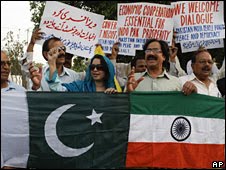
Have the India-Pakistan peace talks collapsed?

Have the India-Pakistan peace talks collapsed?

Are India and Pakistan back to square one as far as peace talks are concerned? Has the dialogue between South Asia's warring neighbours - which appeared to be limping back to some normalcy in the past six months - collapsed?


Triggering off this frenzied debate in India has been Pakistan Foreign Minister Shah Mehmood Qureshi's surprising outburst on Friday blaming India for the talks deadlock: "It seems India is not mentally prepared to engage in a dialogue," he said.

Mr Qureshi's feelings appear to have been provoked by familiar frustrations that have traditionally bedevilled ties between the two sides. Only this time, Pakistan appears to be complaining about India's inflexibility - meaning, among other things, a refusal to discuss thornier issues like Kashmir - impeding a fair dialogue. This is nothing new. India has always held Pakistan is obsessed with Kashmir; Pakistan says India cannot see beyond alleged Pakistani involvement in the 2008 Mumbai attacks.
What prompted Mr Qureshi's sudden broadside against India even as his Indian counterpart was getting ready to board the flight to Delhi? Many in Delhi say that the Pakistani establishment was seething after India's Home Secretary, GK Pillai, accused the Pakistani spy agency Inter-Services Intelligence of being involved in the Mumbai attacks on the eve of the talks. Some are already wondering whether the comments were deliberately aimed to derail the talks - Delhi's foreign policy pundits talks about hawks and doves in the government who are divided over the need for talks with Pakistan. On the other hand, most Indians believe that the Pakistani leadership is not doing enough to rein in militants launching attacks on India, and clerics indulging in hate campaigns against India.

What left most baffled was Mr Qureshi's personal attack on Mr Krishna, that he kept interrupting their meeting by taking calls from Delhi - something which many in India find a breach of diplomatic etiquette. Mr Krishna has denied the allegation.

But then nobody expected any dramatic breakthroughs in the Islamabad talks. The Indian media echoed the sentiment in their coverage today. One bland headline simply said: "India, Pakistan decide to remain engaged." That is how low expectations are in India about ties with its estranged sibling these days.
But browsing the Pakistani media, I came away with the impression that the frustration was higher on the other side of the border. The News, a Pakistan daily, lamented that the talks had "collapsed, not for the sheer absence of the right momentum, but because of India's inflexibility."


Clearly, Mr Qureshi's outburst will make it difficult for India to sell the talks to its people - a leader of the main opposition BJP, a Hindu nationalist party, has already demanded that talks be called off. But the two sides need to keep talking. Because when it comes to two nuclear-armed hostile neighbours, not talking can be more perilous for both. Pakistan's frustration with a stalemate should not surprise many. "Stalemate [between India and Pakistan] seems to be more attractive to each side that finding a solution," says Stephen Cohen, a regional specialist at the Brookings Institution, a US foreign policy think tank. The problem is that this prolonged, agonising stalemate hurts the people of both the countries, and ensures the region's future remains in jeopardy.

Tuesday, June 29, 2010

Pakistan president to visit China as nuclear deal advances

China said on Tuesday that it will host Pakistani President Asif Ali Zardari for top-level talks in early July, but would not say whether a controversial nuclear energy deal between the two nations will be discussed.
Zardari is a regular visitor to China, and his next trip from July 6 to 11 will include meetings with President Hu Jintao and Premier Wen Jiabao, Chinese Foreign Ministry spokesman Qin Gang told a regular news conference.


The announcement of the visit follows signs that China is moving forward with long-discussed plans to build two nuclear reactors at Pakistan's Chashma atomic complex, expanding a project that has worried Washington and India.

Two Chinese nuclear companies this month signed a contract to cooperate in construct the third and fourth plants at Chashma, building on China's rule at the complex in Punjab province. Pakistan faces severe power shortages.

Qin did not directly answer reporters' questions about whether the deal will be discussed during Zardari's visit.
"Both sides will exchange views on how to advance friendly cooperation in all areas, and also on international and regional issues of shared concern," said Qin.

Mounting indications that China will proceed with the reactor expansion in Pakistan, troubled by militant groups, have stirred international misgivings, especially in neighbouring India and the United States, who have their own nuclear energy deal.

The United States said this month it wanted clarification from China on the proposed plants.

Pakistan and India are rivals, and both possess nuclear weapons and stay outside the nuclear Non-Proliferation Treaty.

Islamabad has looked to Beijing to counter to Indian influence. In past decades, Chinese expertise was crucial to Pakistan's nuclear weapons programme, experts widely believe.

The proposed China-Pakistan nuclear energy deal was discussed last week by the Nuclear Suppliers Group, a body of 46 governments that seek to control access to their nuclear fuel and reactor technology to prevent the spread of atomic weapons.

The Chinese spokesman Qin said that any nuclear cooperation with Pakistan should not worry any other countries.

"Cooperation between China and Pakistan for the use of nuclear energy fully conforms with the international non-proliferation undertakings assumed by both countries and is entirely for peaceful purposes," he said.

Pakistan president to visit China as nuclear deal advances

Monday, June 28, 2010

South Asia facing severe terrorist problem: PC

Union Home Minister P Chidambaram has said the South Asian Region is facing severe terrorist problems, and urged all the nations for 'complete cooperation' in fighting the menace.


He was speaking at third SAARC (South Asian Association for Regional Cooperation) Interior/Home Ministers meeting recently held here.

"We can all undoubtedly agree that the South Asian region is faced with a serious security situation. The increasing threat of terrorism poses a major challenge to the maintenance of peace and security and adversely affects economic development in our region." said Chidambaram.

'Unfair to say Pakistan has not done enough'

"It is only with the fullest cooperation among our countries that we will be in a position to effectively tackle the grave threat of terrorism in our region" he said.

Chidambaram asked other members of this region for 'complete sharing' of terrorists and planned terrorist activities.

"We also need to cooperate with each other in sharing information on potential terrorists and planned acts of terrorism, and all other forms of criminal activity, in order to create a more secure environment." he said.

He asked for implementation of a regional convention for the sharing of evidence among member states as well for confiscating funds meant for criminal and terrorist act.
"The 16th Summit recognized the value of the proposed UN Comprehensive Convention on International Terrorism and called for its early conclusion. I would urge all Member States to work together to implement this directive by our Heads of State and Government to ensure the early conclusion of the Convention on International Terrorism." said he.

PC further said: "India will be pleased to host a meeting of the High Level Group of Eminent Experts to Strengthen SAARC Anti-Terrorism Mechanism as recommended in the SAARC Ministerial Declaration on Cooperation in Combating Terrorism. We propose to hold this meeting in New Delhi in January 2011".

South Asia facing severe terrorist problem: PC

Monday, June 21, 2010

Keen on gas deal with Iran: Pakistan

Keen on gas deal with Iran: Pakistan

Pakistan said that it will not violate the international law but has hopes on the multi-million dollar gas pipeline project with Iran. Pakistan made its stand clear following a warning by the United States on the project with Iran.

Shah Mehmood Qureshi, Pakistan Foreign Minister said that it would be premature to give a final opinion on whether US sanctions targeting Iran could affect the project. His statement came a few hours after US special envoy Richard Holbrooke said that he had asked Pakistan not to 'over-commit themselves' until we know the legislation.

Qureshi added that the gas pipeline project worth 7.5 billion dollars should remain intact as it is in the best interests of the nation at a time when it is grappling with an energy crisis. Qureshi was addressing the media in Multan where he made the opinions of Pak about this issue, clear.

He said that Pakistan will protect its interests with regard to energy, which is very essential for the country.
"All the different phases of the gas pipeline agreement have been finalised and we wish that it should proceed forward," Qureshi said.

Friday, June 18, 2010

Indian, Pakistani foreign secretaries to hold talks June 24

Indian, Pakistani foreign secretaries to hold talks June 24

India and Pakistan are bracing for a string of meetings aimed at bridging the trust deficit, starting with Foreign Secretary Nirupama Rao's talks with her Pakistani counterpart Salman Bashir in Islamabad June 24 that will set the stage for the July 15 meeting between the foreign ministers of the two countries.


The meeting between Rao and Bashir flows from an understanding between Prime Minister Manmohan Singh and his Pakistani counterpart Yousaf Raza Gilani in Thimphu April 29.
In an attempt to revive dialogue that froze after the Nov 26, 2008 Mumbai terror attacks, the two leaders had directed their foreign secretaries and foreign ministers to meet and work out the modalities of reducing the trust deficit between the two countries.

Rao will also call on Pakistan's Foreign Minister Shah Mahmood Qureshi, the external affairs ministry said here Friday while announcing the foreign secretary-level talks.

Rao and Bashir are expected to discuss an entire gamut of bilateral issues, including terrorism, Jammu and Kashmir, confidence building measures and the sharing of river waters.

The meeting is expected to flesh out the agenda for the talks between foreign ministers of the two countries in Islamabad July 15.

Rao's trip will be followed by a visit by Home Secretary G.K. Pillai to Islamabad to attend the SAARC Home Secretaries meeting, that will firm up the agenda for a meeting of home ministers of the 8-nation South Asian Association for Regional Cooperation (SAARC) in the Pakistani capital June 26.

Home Minister P. Chidambaram will represent India at the regional meet and will also hold talks with his Pakistani counterpart Rehman Malik that are expected to be dominated by India's concerns over terrorism.

Outlining India's approach ahead of the talks, Rao said at a seminar recently that India was ready to address all issues of mutual concern through dialogue and peaceful negotiations for bridging the trust deficit between the two countries.

Rao asked Pakistan to stop using terrorist groups 'selectively as strategic assets' and stressed that both countries should seek 'creative solution' to complex issues like Jammu and Kashmir that have shadowed their relations.

Thursday, June 17, 2010

Taliban expanding network in Pak's military, political heartland- Punjab

Taliban expanding network in Pak's military, political heartland- Punjab

The recent string of bloody terror attacks across the Punjab province have put a stamp on fears that militancy has deep rooted itself in the political and military heartland of Pakistan.


The emergence of a new extremist network known as the Punjabi Taliban, which has strong ties with both the Taliban and Al-Qaeda, is certainly a cause of worry not only for the provincial government but also for the federal government, which is already facing the heat of militancy in the lawless tribal regions along the Afghan border.

The Punjabi Taliban is believed to have joined hands with various local terrorist groups such as the Jaish-e-Mohammed (JeM), Lashkar-e-Jhangvi (LeJ) and the Sipah-e-Sahaba Pakistan (SSP), which has made matters worse.
Even Rana Sanaullah, the provincial Law Minister, admits that at least 20 to 30 percent members of local terror groups have joined forces with the Punjabi Taliban network to wreak havoc in Punjab.

Despite admitting that the situation is fast spiralling out of control, Sanaullah has objected to calls for a full-scale military operation in the region to quell the terror threat, saying the real threat comes from the training camps in terror hot bed North Waziristan.

However, observers believe that Sanaullah and many provincial leaders like him are against military action against these terror groups because they hugely rely on them for their political ambitions.

It is worth mentioning here that Sanaullah had attracted wide criticism after he was seen hobnobbing with leaders of banned terror outfit Sipah-i-Sahaba Pakistan (SSP) during a local election in Jhang a few days ago.

Tuesday, June 1, 2010

Backgrounder: Major deadly violences in Pakistan in 2010

Backgrounder: Major deadly violences in Pakistan in 2010

Pakistan witnessed some deadliest incidences of violence so far in 2010. The violence has been on increase in Pakistan's heartland eastern part, Punjab.


Major incidences of violence starting from the bloodiest attack on the very first day of the year are given in chronological order bellow.

May 28: More than 95 people were killed and 108 others were injured as gunmen armed with hand grenades and suicide jackets stormed into two Ahmadi mosques in the eastern Pakistani city of Lahore during Friday prayers. The two attacks were carried out nearly simultaneously, at Garhi Shahu and Lahore Model Town, 15 km apart. Militants' groups identified themselves as Al-Qaeda Al- Jihad and Tehrek-e-Taliban Pakistan-Punjab. One attacker was killed, another suicide bomber was captured by worshippers.

April 19: At least 23 people were killed and more than 40 others were wounded after two bomb attacks hit the northwest Pakistani city of Peshawar. The first attack occurred when a bomb exploded outside a school run by a police welfare foundation, killing one person and injuring another 10. The second attack involved a suicide bomber who had targeted a political rally near crowded market area.

April 17: At least 41 people were killed and more than 50 others injured after two suicide bombers attacked an Internally Displaced Persons(IDPs) camp in northwest Pakistan's Kohat city.

April 16: At least 10 people were killed and another 35 were injured after a suicide bomb attack took place at a hospital, in the southwest Pakistani city of Quetta. A TV cameraman, as well as two police officers were among the dead in the attack.

April 5: At least 49 people were killed and more than 50 others were wounded after a suicide bomber attacked a political party rally in the Lower Dir district, bordering tribal areas in Pakistan. Minutes after the blast unknown militants attacked the U. S. consulate in the city of Peshawar. It has been reported that at least seven people were killed in the attack in Peshawar.

March 13: A suicide blast near the city of Mingora, northwest Pakistan's Swat Valley, left 10 people killed and 37 others injured.

March 12: Two suicide bomb attacks in Lahore resulted in the deaths of at least 45 people and wounded 100 others. Both of these bomb attacks reportedly targeted military vehicles as they were passing through a crowded area.

March 8: A suicide bomb attack killed at least 13 people in Pakistan's eastern city of Lahore, provincial capital of Punjab, and wounded more than 60 others. The bomber reportedly rammed his explosive-laden vehicle into a building that housed an anti- terrorist wing of the federal investigative agency.

March 5: 12 people were killed and another 25 were injured in the Hangu district of northwest Pakistan when a suicide bomber targeted a convoy of vehicles traveling from the Hangu district to the Kurram region.
Feb. 18: A bomb attack in crowded a market resulted in the deaths of at least 15 people and wounded more than 100 others in Pakistan's Tirah valley of the Khyber tribal region.

Feb. 11: Two bomb explosions in Bannu district in the northwest, near a police compound, left at least 12 people killed and another 20 injured.

Feb. 5: At least 13 were killed and 50 injured in a blast in a mini bus near Nursery Road in Karachi. After two hours the second planted bomb blasted at motorcycle stand emergency gate of government Jinnah hospital killing 10 and injuring dozens others including rescuers.

Feb. 3: At least 10 people were killed, including three U.S. soldiers, when a bomb blast hit a convoy near a school in the northwest region of Pakistan. Three schoolgirls were also among the dead and it is believed that this blast injured up to another 70 people within the area.

Jan. 30: A suspected suicide bomber killed at least 16 people and wounded 20 others, when he attacked a checkpoint in the northwestern Pakistani town of Khar, headquarters of Bajaur tribal region.

Jan. 1: At least 105 people were killed and dozens of others injured when a suicide bomber blew up his vehicle in a crowd watching a volleyball game in the southern district of Lakki Marwat in the northwestern part of Pakistan.

12 killed including 4 policemen in hospital attack in Lahore of Pakistan

12 killed including 4 policemen in hospital attack in Lahore of Pakistan

At least 12 people were reportedly killed in an on-going terrorist attack at the Jinnah Hospital in Pakistan's eastern city of Lahore, which started at around 12 o'clock (local time) on Monday night.


The 12 people killed included 4 policemen. At least three to four unknown gunmen were involved in the terrorist attack. The gunmen attacked the emergency ward of the Jinnah Hospital where several injured people of the Friday attacks in Lahore as well the terrorists arrested under injured condition of the Friday massacre were admitted.

Local media reports said that the hospital attackers held patients, attendants and hospital staff hostage while firing back at the police who arrived at the spot shortly after the attack was launched.

Latest reports from Xinhua sources in Lahore said the attackers have run away after a brief crossfire with the police.

Sunday, May 30, 2010

World Bank sets Pakistan tight deadline

World Bank sets Pakistan tight deadline

KARACHI - The World Bank has set President Asif Ali Zardari a 48-hour deadline to force through a 6% increase in electricity tariffs and secure implementation of value-added tax (VAT) or face the withholding of US$300 million under a poverty reduction support scheme, according to reports.

The government is "alarmed and clueless" about how to fulfill the conditions by the May 27 deadline, the PakTribune reported. Analysts say it will be hard for the government to take the required measures, both deeply unpopular, in such a short timeframe.

Increasing power charges and imposing VAT are seen by the International Monetary Fund (IMF) and World Bank as necessarysteps in increasing revenue for the cash-strapped government.

The World Bank has told Pakistani authorities that they will have to show clear-cut progress on three actions by May 27, after which documents will be circulated among the World Bank's board of directors on the basis of which it will consider approval of $300 million under the Poverty Reduction Support Credit at its scheduled meeting on June 29 in Washington DC, the PakTribune reported, without citing sources. The third required action is the establishment of single treasury accounts.

If Pakistan successfully implements the VAT and power tariff conditions, the approval of $300 million will be made during the World Bank meeting, Dawn newspaper reported, without citing sources.

A less rigid stance by the World Bank was reported by Pakistan's Daily Mail, which said the World Bank will continue its assistance program for Pakistan even if Islamabad fails to implement an integrated VAT from the next fiscal year, which starts on July 1.

"But Pakistan will have to give credible reasons for the failure," the Daily Mail report said, quoting an unidentified "top source" at the bank.

The central government at present is at loggerheads with the government of Sindh province, which wishes to keep control over the collection of VAT on services. Prime Minister Yousaf Raza Gilani is expected to convene a meeting this week to resolve the stalemate.

Islamabad has already failed to meet an April 1 IMF deadline for increasing electricity tariffs, while VAT is a requirement the IMF set when it agreed in in November 2008 to give Pakistan a US$7.6 billion emergency package to avert a balance of payments crisis. The amount was raised to $11.3 billion last July.

The World Bank has been assisting Pakistan in preparations to introduce VAT during the past year, even as business communities across the country have argued strongly against it. Rules and regulations have been finalized for implementation of the tax from July 1.

The Pakistani business community wants VAT to be postponed for the next two to three years so that tax authorities can develop a payment mechanism and remove anomalies in the proposed VAT regime.

"The government has been urged to amend the proposed VAT law, create awareness on the subject among prospect taxpayers by holding seminars and using other effective tools to spread related information and improve confidence of the taxpayers," The News reported Zakaria Usman, vice president of the Federation of Pakistan Chambers of Commerce and Industry (FPCCI), as saying. "Every country in the world, wherever the said tax is collected, designed it in accordance with the prevailing conditions."

Critics also say that VAT will add to inflationary pressures prices. Replacement of the existing general sales tax (GST) with VAT would increase the prices of over 122 categories of items including food by at least 15%, The Nation reported. About 22 categories in the food group and agriculture, currently exempt from GST, would be brought under the tax net through VAT, it said.

Some analysts believe that imposition of VAT could spark widespread tax evasion as a protest from businesses and a public that has been ill-prepared for the change.

The general population and industry are already feeling the burden of rising prices for petroleum products, electricity and gas, which the government has raised steadily since January, in line with its IMF bailout terms. Inflation rose to a three-month high of 13.26% in April, as the impact of increased oil costs pushed up the price of food.

Cutting inflation by raising interest rates is made more difficult by the fact that these are already among the highest in the world. This week, the central bank kept its policy discount rate unchanged at 12.5%, where it has held since it was cut three times in 2009.

Pakistan’s discount rate is the highest among the benchmark interest rates of 53 central banks, according to the Bloomberg. The equivalent rate in neighboring India is at 5.7%, while Lebanon’s repurchase rate is the second-highest at 12%.

Tuesday, May 18, 2010

Obama's AfPak flip-flop

Obama's AfPak flip-flop


On stage, it would be farce. In Afghanistan and Pakistan, it's bound to play out as tragedy.


Less than two months ago, President Barack Obama flew into Afghanistan for six hours - essentially to read the riot act to Afghan President Hamid Karzai, whom his ambassador had only months before termed "not an adequate strategic partner". Chairman of the Joint Chiefs Admiral Mike Mullen followed within a day to deliver his own "stern message".

While still on Air Force One, National Security Adviser James Jones offered reporters a version of the tough talk Obama wasbringing with him. Karzai would later see one of Jones's comments and find it insulting. Brought to his attention as well would be a newspaper article that quoted an anonymous senior United States military official as saying of his half-brother, Ahmed Wali Karzai, a reputedly corrupt powerbroker in the southern city of Kandahar: "I'd like him out of there ... But there's nothing that we can do unless we can link him to the insurgency, then we can put him on the [target list] and capture and kill him." This was tough talk indeed.


At the time, the media repeatedly pointed out that Obama, unlike his predecessor, George W Bush, had consciously developed a standoffish relationship with Karzai. Meanwhile, both named and anonymous officials regularly castigated the Afghan president in the press for stealing an election and running a hopelessly corrupt, inefficient government that had little power outside Kabul, the capital. A previously planned Karzai visit to Washington was soon put on hold to emphasize the toughness of the new approach.
The administration was clearly intent on fighting a better version of the Afghan war with a new commander, a new plan of action, and a well-tamed Afghan president, a client head of state who would finally accept his lesser place in the greater scheme of things. A little blunt talk, some necessary threats, and the big stick of American power and money were sure to do the trick.

Meanwhile, across the border in Pakistan, the administration was in an all-carrots mood when it came to the local military and civilian leadership - billions of dollars of carrots, in fact. Our top military and civilian officials had all but taken up residence in Islamabad. By March, for instance, Mullen had already visited the country 15 times and US dollars (and promises of more) were flowing in. Meanwhile, US Special Operations Forces were arriving in the country's wild borderlands to train the Pakistani Frontier Corps and the skies were filling with Central Intelligence Agency-directed unmanned aerial vehicles pounding those same borderlands, where the Pakistani Taliban, al-Qaeda and other insurgent groups involved in the Afghan war were located.

In Pakistan, it was said, a crucial "strategic relationship" was being carefully cultivated. As the New York Times reported, "In March, [the Obama administration] held a high-level strategic dialogue with Pakistan's government, which officials said went a long way toward building up trust between the two sides." Trust indeed.

Skip ahead to mid-May and somehow, like so many stealthy insurgents, the carrots and sticks had crossed the poorly marked, porous border between Afghanistan and Pakistan heading in opposite directions. Last week, Karzai was in Washington being given "the red carpet treatment" as part of what was termed an Obama administration "charm offensive" and a "four-day love fest".

The president set aside a rare stretch of hours to entertain Karzai and the planeload of ministers he brought with him. At a joint news conference, Obama insisted that "perceived tensions" between the two men had been "overstated". Specific orders went out from the White House to curb public criticism of the Afghan president and give him "more public respect" as "the chief US partner in the war effort".

Secretary of State Hillary Clinton assured Karzai of Washington's long-term "commitment" to his country, as did Obama and Afghan war commander General Stanley McChrystal. Praise was the order of the day.

John Kerry, chairman of the Senate Foreign Relations Committee, interrupted a financial reform debate to invite Karzai onto the senate floor where he was mobbed by senators eager to shake his hand (an honor not bestowed on a head of state since 1967). He was once again our man in Kabul. It was a stunning turnaround: a president almost without power in his own country had somehow tamed the commander-in-chief of the globe's lone superpower.

Meanwhile, Clinton, who had shepherded the Afghan president on a walk through a "private enclave" in Georgetown and hosted a "glittering reception" for him, appeared on CBS's 60 Minutes to flay Pakistan. In the wake of an inept failed car bombing in Times Square, she had this stern message to send to the Pakistani leadership: "We want more, we expect more ... We've made it very clear that if, heaven forbid, an attack like this that we can trace back to Pakistan were to have been successful, there would be very severe consequences." Such consequences would evidently include a halt to the flow of US aid to a country in economically disastrous shape. She also accused at least some Pakistani officials of "practically harboring" Osama bin Laden. So much for the carrots.

According to the Washington Post, McChrystal delivered a "similar message" to the chief of staff of the Pakistani army. To back up Clinton's public threats and McChrystal's private ones, hordes of anonymous American military and civilian officials were ready to pepper reporters with leaks about the tough love that might now be in store for Pakistan. The same Post story, for instance, spoke of "some officials ... weighing in favor of a far more muscular and unilateral US policy. It would include a geographically expanded use of drone missile attacks in Pakistan and pressure for a stronger US military presence there."

According to similar accounts, "more pointed" messages were heading for key Pakistanis and "new and stiff warnings" were being issued. Americans were said to be pushing for expanded special operations training programs in the Pakistani tribal areas and insisting that the Pakistani military launch a major campaign in North Waziristan, the heartland of various resistance groups, including al-Qaeda. "The element of threat" was now in the air, according to Tariq Fatemi, a former Pakistani ambassador, while in press reports you could hear rumblings about an "internal debate" in Washington that might result in more American "boots on the ground".

Helpless escalation

In other words, in the space of two months the Obama administration had flip-flopped when it came to who exactly was to be pressured and who reassured. A typically anonymous "former US official who advises the administration on Afghan policy" caught the moment well in a comment to the Wall Street Journal. "This whole bending over backwards to show Karzai the red carpet," he told journalist Peter Spiegel, "is a result of not having had a concerted strategy for how to grapple with him."

On a larger scale, the flip-flop seemed to reflect tactical and strategic incoherence - and not just in relation to Karzai. To all appearances, when it comes to the administration's two South Asian wars, one open, one more hidden, Obama and his top officials are flailing around. They are evidently trying whatever comes to mind in much the manner of the oil company BP as it repeatedly fails to cap a demolished oil well 1,500 meters under the waves in the Gulf of Mexico. In a sense, when it comes to Washington's ability to control the situation, Pakistan and Afghanistan might as well be 1,500 meters underwater. Like BP, Obama's officials - military and civilian - seem to be operating in the dark, using unmanned robotic vehicles. And as in the Gulf, after each new failure, the destruction only spreads.

For all the policy reviews and shuttling officials, the surging troops, extra private contractors and new bases, Obama's wars are worsening. Lacking is any coherent regional policy or semblance of real strategy - counter-insurgency being only a method of fighting and a set of tactics for doing so. In place of strategic coherence there is just one knee-jerk response: escalation. As unexpected events grip the Obama administration by the throat, its officials increasingly act as if further escalation were their only choice, their fated choice.

This response is eerily familiar. It permeated Washington's mentality in the Vietnam War years. In fact, one of the strangest aspects of that war was the way America's leaders - including president Lyndon Johnson - felt increasingly helpless and hopeless even as they committed themselves to further steps up the ladder of escalation.


We don't know what the main actors in Obama's war are feeling. We don't have their private documents or their secret taped conversations. Nonetheless, it should ring a bell when, as wars devolve, the only response Washington can imagine is further escalation.

Washington boxed in

By just about every recent account, including new reports fromthe independent Government Accountability Office and the Pentagon, the US mission in Afghanistan is going dreadfully, even as the Taliban insurgency gains potency and expands. This spring, preparing for his first relatively minor US offensive in Marjah, a Taliban-controlled area of Helmand province, McChrystal confidently announced that, after the insurgents were dislodged, an Afghan "government in a box" would be rolled out. From a governing point of view, however, the offensive seems to have been a fiasco. The Taliban are now reportedly re-infiltrating the area, while the governmental apparatus in that nation-building "box" has proven next to non-existent, corrupt and thoroughly incompetent.


Today, according to a report by the International Council on Security and Development (ICOS), the local population is far more hostile to the American effort. According to the ICOS, "61% of Afghans interviewed feel more negative about NATO [North Atlantic Treaty Organization] forces after Operation Moshtarak than they did before the February military offensive in Marjah."

As Alissa Rubin of the New York Times summed up the situation in Afghanistan more generally:

Even as American troops clear areas of militants, they find either no government to fill the vacuum, as in Marjah, or entrenched power brokers, like President Karzai's brother in Kandahar, who monopolize NATO contracts and other development projects and are resented by large portions of the population. In still other places, government officials rarely show up at work and do little to help local people, and in most places the Afghan police are incapable of providing security. Corruption, big and small, remains an overwhelming complaint.

In other words, the US really doesn't have an "adequate partner", and this is all the more striking since the Taliban are by no stretch of the imagination a particularly popular movement of national resistance. As in Vietnam, a counter-insurgency war lacking a genuine governmental partner is an oxymoron, not to speak of a recipe for disaster.

Not surprisingly, doubts about McChrystal's war plan are reportedly spreading inside the Pentagon and in Washington, even before it's been fully launched. The major US summer "operation" - it's no longer being labeled an "offensive" - in the Kandahar region already shows signs of "faltering" and its unpopularity is rising among an increasingly resistant local population. In addition, civilian deaths from US and NATO actions are distinctly on the rise and widely unsettling to Afghans. Meanwhile, military and police forces being trained in US/NATO mentoring programs considered crucial to Obama's war plans are proving remarkably hapless.

McClatchy News, for example, recently reported that the new Afghan National Civil Order Police (ANCOP), a specially trained elite force brought into the Marjah area and "touted as the country's best and brightest" is, according to “US military strategists[,] plagued by the same problems as Afghanistan's conventional police, who are widely considered corrupt, ineffective and inept." Drug use and desertions in ANCOP have been rife.

And yet, it seems as if all that American officials can come up with, in response to the failed Times Square car bombing and the "news" that the bomber was supposedly trained in Waziristan by the Pakistani Taliban, is the demand that Pakistan allow "more of a boots-on-the-ground strategy" and more American trainers into the country. Such additional US forces would serve only "as advisers and trainers, not as combat forces". So the mantra now goes reassuringly, but given the history of the Vietnam War, it's a cringe-worthy demand.

In the meantime, the Obama administration has officially widened its targeting in the CIA drone war in the Pakistani borderlands to include low-level, no-name militants. It is also ratcheting up such attacks, deeply unpopular in a country where 64% of the inhabitants, according to a recent poll, already view the United States as an "enemy" and only 9% as a “partner.”

Since the Times Square incident, the CIA has specifically been striking North Waziristan, where the Pakistani army has as yet refrained from launching operations. The US, as the Nation's Jeremy Scahill reports, has also increased its support for the Pakistan Air Force, which will only add to the wars in the skies of that country.

All of this represents escalation of the "covert" US war in Pakistan. None of it offers particular hope of success. All of it stokes enmity and undoubtedly encourages more "lone wolf" jihadis to lash out at the US. It's a formula for blowback, but not for victory.

BP-style pragmatism goes to war

One thing can be said about the Bush administration: it had a grand strategic vision to go with its wars. Its top officials were convinced that the American military, a force they saw as unparalleled on planet Earth, would be capable of unilaterally shock-and-awing America's enemies in what they liked to call "the arc of instability" or "the Greater Middle East" (that is, the oil heartlands of the planet). Its two wars would bring not just Afghanistan and Iraq, but Iran and Syria to their knees, leaving Washington to impose a Pax Americana on the Middle East and Central Asia (in the process of which groups like Hamas in Gaza and Hezbollah in Lebanon would be subdued and anti-American jihadism ended).
They couldn't have been more wrong, something quite apparent to the Obama team. Now, however, we have a crew in Washington who seem to have no vision, great or small, when it comes to American foreign or imperial policy, and who seem, in fact, to lack any sense of strategy at all. What they have is a set of increasingly discredited tactics and an approach that might pass for good old American see-what-works "pragmatism", but these days might more aptly be labeled "BP-style pragmatism".

The vision may be long gone, but the wars live on with their own inexorable momentum. Add into the mix American domestic politics, which could discourage any president from changing course and de-escalating a war, and you have what looks like a fatal - and fatally expensive - brew.

We've moved from Bush's visionary disasters to Obama's flailing wars, while the people of Afghanistan, Pakistan and Iraq continue to pay the price. If only we could close the curtain on this strange mix of farce and tragedy, but evidently we're still stuck in act four of a five-act nightmare.

Even as our Afghan and Pakistani wars are being sucked dry of whatever meaning might remain, the momentum is in only one direction - toward escalation. A thousand repetitions of an al-Qaeda-must-be-destroyed mantra won't change that one bit. More escalation, unfortunately, is yet to come.

Wednesday, May 12, 2010

Cotton May Be New Dispute for India, Pakistan

Pakistan is fighting back after India banned raw cotton exports last month, creating a new bone of contention in an already frosty relationship.
New Delhi says it imposed the ban to ensure its own garment and textile industry has adequate supplies after a poor global harvest of raw cotton, especially in China and the U.S.
Getty Images A farmer rests on sacks of cotton at a market in southern India.


“It’s a slap on the face of free trade in the global economy,” said Mohsin Ayub Mirza, a textile manufacturer in Karachi and chairman of the Pakistan Readymade Garments Manufacturers & Exporters Association.
Pakistan argues that India should honor contracts for 200,000 cotton bales for which letters of credit have already been issued, says Ikhtiar Baig, a Karachi-based garment producer and federal adviser to the government on the textile industry.
“Pakistan is against India’s ban on cotton exports,” Mr. Baig added.
India, like the U.S., is an important exporter of raw cotton. Pakistan and China, despite producing large amounts of cotton, are among the biggest importers because of their large yarn spinning and garment industries.
The two governments are discussing the issue. Separately, in a step forward on Tuesday, both countries said that their foreign ministers will meet in Islamabad in July.
Pakistani garment and textile producers admit they are facing much bigger problems than India’s ban alone. The U.S. Department of Agriculture expects cotton mills to consume 115.9 million cotton bales this year while production will only be 102.9 million bales. Local yarn producers have taken advantage of global cotton shortages to sell their products at high prices in China.
That has exacerbated shortages of yarn in the local market, forcing some textile and garment businesses to shut down and putting people out of work. Yarn prices are up almost 100%.
Tens of thousands of people took to the streets in Karachi and Faisalabad on Tuesday to call for an immediate ban on yarn exports. While peaceful for now, the protests risk further destabilizing India’s neighbor.
But political and business tensions between India and Pakistan don’t appear to be affecting cultural relations. Pakistanis love Bollywood and an Indian film star was chosen as the face of this year’s summer collection of one of Pakistans leading cloth producers — Faisalabad-based Firdous Textile —  although some wonder whether marketing in Pakistan should be using home-grown talent.

http://blogs.wsj.com/indiarealtime/2010/05/12/cotton-may-be-new-area-of-dispute-for-india-pakistan/?mod=wsj_india_main

Tuesday, May 11, 2010

S.M. Krishna says to visit Pakistan on July 15

S.M. Krishna says to visit Pakistan on July 15


Foreign Minister S.M. Krishna said on Tuesday he had accepted an invitation from his Pakistani counterpart to visit Islamabad for talks on July 15, a further sign of improving ties between the rival countries.


"I'm looking forward to these talks," Krishna told a news conference in New Delhi after speaking with his Pakistani counterpart Shah Mehmood Qureshi by telephone on Tuesday.

Last month, the prime ministers of nuclear-armed India and Pakistan held talks in Bhutan and asked their officials to take steps as soon as possible to normalise relations.

"It was a good conversation that we had," Qureshi told reporters, according to comments broadcast on Indian television channels.

"I'm presuming that both sides are comfortable with the structure in place (for improving relations)," he said.

Relations between the the two countries went into a diplomatic freeze after India blamed Pakistan-based militants for the Mumbai attacks in November 2008.

Monday, May 10, 2010

Pak man with batteries, electrical circuit hidden in shoes arrested at Karachi airport

Pak man with batteries, electrical circuit hidden in shoes arrested at Karachi airport


A suspected bomber was arrested at the Jinnah International Airport here after batteries and electrical circuits were found concealed in his shoes after a thorough check-up following a scanner alarm.
 
The man identified as Faiz Mohammad, 30, was scheduled to board a Thai International Airlines flight, No TG-507 for Muscat, The Nation reports.


Confirming the arrest, an airport security force official said Mohammed, who holds a diploma in civil engineering, was apprehended while he was being scanned at the airport before boarding the flight. The scanner sounded an alarm following which a suspicious object was detected hidden in his shoes.

During physical frisking, a device, fixed to his shoes, was recovered, which included four live batteries and a circuit with a switch, the official said.

Initial investigations have revealed that Mohammed hails from Manshera region of the North West Frontier Province (NWFP) and was employed in a construction company in Muscat.

He had returned to Pakistan to get his visa renewed.

Wednesday, April 28, 2010

The recurring nightmare

The story of the House of Bhutto, written by Fatima Bhutto

The irrepressible, inimitable, 90-plus, Khushwant Singh, who has few peers in the subcontinental journalist community, is much taken with young Fatima Bhutto — mind you, he always has had and is renowned for his roving eye. He also has much to say about Fatima’s book Songs of Blood and Sword which he has reviewed twice.

Firstly, in the Hindustan Times on April 17 and then in the April 20 issue of Outlook, the latter under the somewhat gory title of ‘The burnt inside of Pakistan’s house of Atreus’. The House of Atreus is famed for the curse put upon it for murder, betrayal and sheer horror, one of the most enduring of Greek legends.


Atreus of Argos was the father of Agamemnon and Menelaus who respectively married Clytaemnestra and Helen of Troy, and heaven knows there is abundant tragedy and gore in their stories. But the most repellent part of it all concerns the quarrel between Atreus and his brother Thyestes over the affair the latter had with Atreus’s wife which resulted in his banishment from Argos.

Thyestes wished for reconciliation and after some time was allowed to return. Atreus prepared a huge banquet in celebration at which he served up to Thyestes the cooked flesh of his two slaughtered sons. The unknowing father ate and was then informed by his brother of what he had just done — the origin of the term ‘Thyestian Banquet’. Thyestes, horror-stricken, put a curse upon the family of Atreus and fled. The curse, as legend records, worked to perfection.

According to Khushwant the story of the House of Bhutto, written by Fatima in “impeccably beautiful prose would have been a joy to read if it had not been a gruesome tale of intrigue, treachery, treason, violence and cold-blooded murder. It is one long nightmare ….”. Strong stuff, and with justification as we who have followed the Bhutto saga down the years well know, and the betrayal continues with the man we now have in the presidential palace in Islamabad, accompanied by his resident soothsayer.

Fatima is “beautiful, highly gifted and gutsy”. When she called on Khushwant, after launching her book in Delhi earlier this month, he wrote “I could not take my eyes off her. I kept gazing at the pinhead of a diamond sparkling on the left side of her nose and her long jet-black curly hair falling on her shoulders. I hope I see her at least once more before my time is up.”

He is not so enamoured with other member of the family and has harsh words for Zulfikar for “indirectly helping East Pakistan become an independent Bangladesh” because he found it unacceptable that if unity was maintained the East Pakistanis would far outnumber the western lot. So much for democracy! Khushwant also slams him for pandering to the archaic laws of the clergy merely to hang on to power.

He is scathing of Bhutto’s betrayal of Manzur Qadir, Ayub Khan’s foreign minister. As a fellow cabinet minister, Bhutto denounced Qadir as being a free-thinker and not a good Muslim. He was consequently dropped from the cabinet and ultimately Zulfikar moved into his slot. Khushwant also touches upon the J.A. Rahim incident, and his beating up by PPP goons merely because Rahim left a dinner after waiting for two hours for Bhutto to turn up.

As for Zulfikar’s son-in-law, he shares Fatima’s “low opinion” of him, refers to his indulgence in shady deals and terms him “uncouth and foul-mouthed”. He blames Benazir for doing little in her two terms to improve the lot of the common people. His closing lines in the Hindustan Times: “Incidentally, I also added a new word to my vocabulary which fits both Pakistan and India. It is ‘saprophytic’, which means feeding on decaying organic matter. Both nations rely on all that is rotten in their past.”

The book was also reviewed in London’s Sunday Times on April 4, by Max Hastings, who likens it to a Jacobean drama rather than a Greek tragedy, cataloguing the list of hanging, poisoning, terrorism, murder and assassination — “hate and blood” he terms it.

The content to him is “emotional, partial, naïve and wholly unreliable about who really did what to whom. But it possesses readability from those with a taste for family horror stories”. He is totally unsympathetic to all the characters, and spells out his factual reasons citing acts of omission and commission perpetrated by Fatima’s grandfather, her father, her uncle and her aunt, all of whom in ways most discernible were flawed characters.

Hastings is unforgiving to Fatima for her “blind rejection of any pretension to insight or judgment”. This may be unkind, for it would take an extraordinarily strong character to be objective about a hanged grandfather, a murdered father and uncle, and an assassinated aunt. She must be given leeway for having had a childhood and youth so tainted by tragedy and violence as to make the admittance of hard historical fact difficult indeed.

As admits Hastings, the “book’s virtues derive from the author’s passion and some vivid pen portraits”. Hastings’s own vivid pen portrait of Asif Zardari, Benazir’s husband, is that he is “considered by some to be the most notoriously corrupt figure in the subcontinent” and that he “climbed over her corpse to become Pakistan’s president….”

As strong a stuff as that of Khushwant! And his ending must make us all, including those who sit atop us, pause and think: “But she conveys a terrifying sense of the ungovernability of Pakistan and its 180m people, exposed to the competing violence of rulers and rebels. Another army coup must be due some day soon.”

Monday, April 26, 2010

SubContinentFocus, Todays Highlights: India, Afghanistan discuss Taliban, regional security, Pakistan electricity crisis and trouble in Kashmir

SubContinentFocus, Todays Highlights: India, Afghanistan discuss Taliban, regional security, Pakistan electricity crisis and trouble in Kashmir

Afghan President Hamid Karzai held talks with Indian leaders on Monday about his efforts to reach out to the Taliban for a negotiated settlement of the nine-year old conflict in his country.


New Delhi fears any Afghan plan to broker a deal with the Taliban will undermine its security and give rival Pakistan greater influence there. Pakistan, one of a handful of countries that recognised the Taliban regime before the U.S. invasion in 2001, is seen as a key player in any plan for reconciliation.


"We discussed... reintegration and reconciling of those elements of the Taliban and others who have accepted the Afghan Constitution, who are not part of al Qaeda, who are not part of any terrorist network," Karzai said after talks with Indian Prime Minister Manmohan Singh.

Karzai has proposed a plan to reintegrate low-level fighters back into Afghan society and also sought to reconcile with senior insurgents provided they give up weapons.

An immediate breakthrough is unlikely, analysts say, pointing to previous offers to re-integrate fighters that failed to make much progress. The Taliban have also rejected any offer of talks saying foreign forces must first leave Afghanistan.

"The prime minister and I discussed the situation in Afghanistan, the situation in the region and our common struggle against terrorism and extremism," Karzai said reading from a statement.

Karzai will be travelling to Bhutan on Tuesday to attend a regional summit where the prime ministers of India and Pakistan will also be present and could meet, Indian Foreign Minister S.M. Krishna said on Monday.

"I am not ruling it out," the state-run Doordarshan channel quoted him as saying in Thimphu, the capital of Bhutan, of a possible meeting between the leaders of India and Pakistan.

The rivalry between India and Pakistan has extended to Afghanistan where the two are battling for influence.


New Delhi saw a militant attack on a Kabul guest house that killed six Indians in February as a signal of efforts to reduce New Delhi's influence in Afghanistan. It was the third major attack against Indian interests in two years.

"I conveyed to President Karzai that the perpetrators of such attacks will not succeed in undermining India's commitment to assist the Afghan people," Singh said in his statement.

Pakistan denies any involvement and in turn accuses India of using Afghan territory to destabilise its troubled Baluchistan region.

New Delhi has several developmental projects in Afghanistan, including construction of power lines and highways worth $1.3 billion.

On the other hand, Pakistani government announced on Thursday measures to cut state electricity consumption by half, as Pakistan battles a chronic energy shortage which is inflaming public anger and stifling industry.

Syed Yousaf Raza Gilani, the pakistan PM told a news conference that the main reason for the shortage is that past governments failed to anticipate growth in demand and delayed implementing power and dam projects that would have boosted output.


Moreover, mogul Lalit Modi  the head of India's $4 billion cricket premier league was removed from his post on Monday after a scandal that has ensnared top politicians and strained the ruling coalition.

Lastly, insurgency in kashmir continues, marches agaist the death sentences of 1996 Lajpat nagar prisoners, police clashes with the youth and ban on islamic channels still continues. 

Friday, April 23, 2010

South Asia summit: India Pakistan in focus

India, Pakistan in focus at South Asia summit

Leaders of India and Pakistan are likely to meet in Bhutan's capital next week as their nuclear-armed rivalry overshadows a summit of South Asian nations to discuss trade and environment.


Peace talks between the two nations were erupted after the November 2008 Mumbai attack which caused 166 fatalities which India blamed Pakistan-based groups involvement in the attack.

A meeting between the leaders is seen as crucial because it could help keep alive the idea of engagement between two players whose battle for influence in Afghanistan has a direct bearing on Western efforts to stabilise a region with 1.8 billion people.

A senior Indian Government official (who spoke on condition of anonymity) said that it is an opportunity and both sides will take advantage of it. On the other hand, Foreign Secretary Nirupama Rao said there was "as of now" no offer of a bilateral meeting between Prime Minister Manmohan Singh and his Pakistani counterpart, Yousaf Raza Gilani, but did not completely rule out the possibility of one.

The two sides have been hesitant about engaging since their top diplomats met in New Delhi in February but failed to achieve a breakthrough. That meeting, nonetheless, was seen as a small step towards repairing ties.

Differences over the nature of talks have held up a further meeting -- Pakistan wants India to restart the peace process; India wants to go slow until Islamabad acts against the Mumbai attack planners.

The United States has been urging the two sides to reduce tension so that Pakistan can focus better on fighting the Taliban on its western border with Afghanistan.

Before leaving for Bhutan on Friday, Rao said"I don't really want to forecast what is going to happen, but let me say: dialogue is always useful, it helps clear the atmosphere, especially between close neighbours such as India and Pakistan".

Abdul Basi,t Pakistani Foreign Office spokesman hinted last week about the possibility of a meeting. "It has not yet been penciled in. Nevertheless, given that our roadmap also provided for a summit meeting in Bhutan, we look forward to a meaningful engagement with India".

"Let me also underline here, that engaging in meaningful and result-oriented talks is in our mutual interest and in the interest of this region, it is not a favour by Pakistan to India and vice versa."

COOPERATION UNDERMINED

The scale or content of a meeting between Singh and Gilani could be drawn up by Rao and her Pakistan counterpart, Salman Bashir. Indian officials said hopes of any progress were low.

"Our outlook on the meeting is very clear -- it has to be terrorism and what steps Pakistan has taken to bring the perpetrators of Mumbai to book," a senior Indian official said on condition of anonymity.

The two sides' unmitigated animosity has undermined greater regional cooperation, an agenda that was the founding principle of the eight-nation bloc of South Asian Association for Regional Cooperation (SAARC) that meets in Bhutan on April 28-29.

Nepal, Sri Lanka, Bhutan, the Maldives, Bangladesh and Afghanistan make up the rest of the group.

While SAARC summits are often little more than a backdrop to bilateral meetings between India and Pakistan, the bloc has tried to push forward cooperation in trade and commerce.

Thursday, April 22, 2010

US seeks Pak-Afghan reconciliation

US seeks Pak-Afghan reconciliation

Detached twins to reconcile:

WASHINGTON: ‘Detached twins’ Afghanistan and Pakistan will join other regional and international players on July 20 in Kabul to work out a plan for stabilising the war-ravaged country, says US special envoy Richard Holbrooke. Secretary of State Hillary Clinton will attend the conference and the United States expects Pakistan to send either President Asif Ali Zardari or Prime Minister Yousuf Raza Gilani. “You can’t succeed in one unless you succeed in both,” said Mr Holbrooke who told a briefing in Washington that the United States also had mended its relations with Afghan President Hamid Karzai. “There was a period where the waters got roiled a little bit, but that period is over,” he said while describing the Obama administration’s relations with the Karzai government.

President Karzai will visit Washington from May 10 to 14 and soon afterward will hold a peace jirga in Kabul for outlining the contours of a reconciliation offer to the Taliban.

Mr Holbrooke said the Kabul conference would be an affirmation of international support for the Afghan government and would replace a meeting of foreign ministers originally set for late May.

The US effort for mustering international support for the Karzai government contrasts sharply with its earlier retaliatory statements against Mr Karzai who at one stage threatened to join the Taliban if he didn’t get to control an election monitoring cell.

Since the Kabul conference will follow the jirga, the Afghan government is expected to come to the meeting with a blueprint for a future set-up. This may include some Taliban leaders as well.

But it is not clear if the new arrangement will protect Pakistan’s interests as well or it will reflect the Indian desire to continue to keep Islamabad out of Afghanistan.

Mr Holbrooke said the United States had made “enormous strides” in persuading Afghanistan and Pakistan to “work together more closely” but the two ‘detached twins’ still had their differences.

“I think everybody agrees that there’s been improvement in that particular area but that’s improvement from a very low base,” he said, adding that the relationship between Pakistan and Afghanistan was “still not where you’d want it to be”.

Although the two countries need each other to defeat terrorism; “they’re so different in every sense, including our relationship with them”, said the US envoy. “And the management of the inter-relationship is why we created the trilateral framework and why we want to resume it this summer.”

Mr Holbrooke conceded that others had legitimate interests in Afghanistan too, such as China and the three “stans” who shared their borders with Afghanistan.

Other actors in the Afghan game include Iran as well as states that do not border Afghanistan — all the way from the Gulf to India, Russia and the United States, he said.

“This is what makes Afghanistan so extraordinarily important and complex,” said the US diplomat.

While conceding the importance of each of these actors in determining Afghanistan’s future, Mr Holbrooke pointed out that Kabul and Islamabad were still the two key players and that’s why the Obama administration was working so hard to improve their ties.

According to him, there will be another trilateral meeting of the United States, Pakistan and Afghanistan before the international conference. The last such meeting was held on May 6 and 7 last year.

“We had two trilateral meetings in the first few months of last year. Then we did bilaterals first with the Pakistanis, the Strategic Dialogue last month, and now upcoming with the Afghans. Then they go through their processes, they hold a conference, and then we go back to the trilateral,” said Mr Holbrooke while underlining US efforts to improve relations between Islamabad and Kabul.

“There is a real choreography involved here,” he concluded.

Tuesday, April 20, 2010

WITNESS - Breaking the myths of Pakistan's tribal areas

WITNESS - Breaking the myths of Pakistan's tribal areas

By Myra MacDonald
KHAR, Pakistan - I had not expected Pakistan's tribal areas to be so neat and so prosperous.

These are meant to be the badlands, mythologised as no-go areas by Kiplingesque images of xenophobic Pashtuns, jezail musket in hand, defying British troops from rugged clifftops.

They are the "ungovernable" lands where al Qaeda took sanctuary after the 2001 invasion of Afghanistan; the bastion of Islamist militants said to threaten the entire world.

Yet to fly by helicopter for the first time into Bajaur tribal agency is to challenge the more wildly imagined cliches about this little-visited region on the Pakistan-Afghan border.

Here, in the northernmost part of the Federally Administered Tribal Areas (FATA), you realise this region is no longer as ferocious as feared and that while militants still call the shots in parts of FATA, Bajaur at least is somewhat pacified.

The Pakistan army knows this and has brought us, a small group of foreign journalists, to Bajaur to try to convince us it has turned a corner in its battle against Islamist militants.

It is a message we are given repeatedly on a whirlwind tour of the country. In Islamabad, the city is relatively relaxed despite the many checkpoints, the jacaranda trees are in bloom and families are back out strolling in the parks.

A minister reminisces about the bars of his student days; an official remembers the more peaceful country that existed before the jihad against the 1979-89 Soviet occupation of Afghanistan.

In Karachi, businessmen party through the power cuts and talk up the stock market; in Lahore, academics speak of the potential cultural revival of a country of 170 million people.
The still-frequent bombings and lingering militant hideouts, including in North Waziristan on the Afghan border, give plenty of grounds for scepticism. But visiting Bajaur is meant to make you believe that something has changed.

FORT UNDER SIEGE

Our helicopter lands in Khar, at a fort which less than two years ago was under siege with rockets raining down every day.

Authorities had ceded control of the surrounding area running up to the Afghan border to militants believed to have once offered sanctuary to al Qaeda leader Ayman al Zawahiri.

It became so bad that, according to one military official, the army feared even the fort would be overrun, the troops inside either massacred or taken prisoner en masse.

Outside the fort, the militants ran their own checkpoints, collected revenue, beheaded prisoners in the bazaar and convinced every family to offer up one male child to the cause.

Even reopening a marble factory required written permission from the militants; another man -- according to the army -- turned himself from labourer to landlord by successfully navigating the paperwork of their newly created bureaucracy.

Now we are able to drive out of the fort towards the border to inspect an abandoned former stronghold of the Taliban.
This is a region which we are told was run according to a 6,000-year-old tribal system -- primitive say some, mature say others -- where each individual was so clear of his or her obligation to society that it worked "perfectly" in its own way.

The fields are either neatly terraced or carefully laid out and the land is well-tended and fertile. If you have travelled in South Asia, it looks remarkably prosperous, either thanks to the old tribal order or money sent in by workers in the Gulf.

The terrain is hilly rather than rugged, although the mountains rise up at the Afghan border in the distance.

The old order broke down with the CIA-backed Pakistan-led jihad against the Soviets which stressed pan-Islamism over tribal loyalty; it nearly collapsed altogether with the flood of fighters fleeing the U.S.-led invasion of Afghanistan in 2001.

The militants became so entrenched that when Pakistani authorities tried to reassert control in 2008 by setting up a checkpoint at the region's main crossroads, the 150 troops there found themselves surrounded by a thousand fighters.

They began to run out of water and ammunition and each party sent from Khar to rescue them was ambushed. Eventually, after fierce fighting, 140 made it back to Khar. But it was enough to convince the army to launch a full-scale military operation.

In February, the army cleared out the last of the main militant strongholds in Bajaur after months of intense fighting which destroyed villages, left gaping wounds in buildings from rocket-propelled grenades (RPGs), and sent villagers fleeing.

MYTH BROKEN
Our small group drives out of the fort of Khar in pick-up trucks, soldiers standing in the back around a rather alarming stack of black-tipped RPGs meant to guarantee our safety.

The roads here are better than in much of South Asia and we drive fast -- presumably to avoid a bullet from a lone gunman or a remotely triggered IED. It is clear that while the strongholds may have been overrun, the area is still not secure.

Yet the atmosphere is less threatening than I had felt for example in Kashmir at the height of the insurgency there.

The crowds of men we come across along the road stare, but without menace. The young girls in white, their heads but not their faces covered, ignore us. Women are nowhere to be seen.

The soldiers who fan out when we reach the abandoned stronghold at Damadola some 20 minutes drive away, where local militant leader Fakir Mohammad once held court, are watchful but not jumpy.

At the very least, the myth of the "ungovernable" tribal areas -- so beloved of Raj-era tales -- has been broken.

The militants were so well entrenched at Damadola that only when the fighting intensified did they put up a sign asking local people to stop bringing their disputes for settlement.

As the army pressed forward, some militants escaped, including the leaders, into Afghanistan, or back into the population. Some were captured, many were killed. The last of them retreated into a warren of caves dug out of the hillside.

You have to stoop low to get through the narrow tunnel at the entrance to the caves, fighting claustrophobia before you can stand up straight again in a dark cavern.

The army says it cleared these caves one by one, throwing in smoke grenades and then opening fire. For some of the local boys, given up by their families to join the militants, this would be the last they saw of their neat and prosperous land.

Friday, April 16, 2010

UN inquiry says Benazir Bhutto murder was 'avoidable'

UN inquiry says Benazir Bhutto murder was 'avoidable'

A long-awaited UN report on the assassination of Pakistani politician Benazir Bhutto in 2008 has been highly critical of the government of the day.
It says Bhutto's death at a rally near Islamabad could have been prevented if proper security measures had been taken by Gen Pervez Musharraf's government.

The report also criticised the subsequent investigation and urged Pakistan to launch a "credible" probe.

Bhutto's Pakistan People's Party (PPP) said it was satisfied with the inquiry. Senior party leaders told the BBC that the findings were "exactly what they had been saying all along".

The report would give a shot in the arm to ongoing police investigations, spokesman Farhatullah Babar said. Another aide said it could pave the way for a proper police investigations and possible penal proceedings.

Crime Scene 'Hosted'

The report, compiled by an independent commission appointed by the UN, concluded that the pervasive presence of Pakistan's politicised intelligence agencies hampered the investigation.
It said the crime scene in Rawalpindi was hosed down immediately after the explosion.  This, the report said, could not have happened without the knowledge of higher authorities. The commission was set up in July last year in response to a request from Pakistan.

Speaking at a news conference at the UN in New York, the head of the commission, Heraldo Munoz, said the authorities had failed to protect Bhutto and to investigate her assassination properly.

"A range of government officials failed profoundly in their efforts, first to protect Ms Bhutto and second to investigate with vigour all those responsible for her murder, not only in the execution of the attack but also in its conception, planning and financing," he said.

"Responsibility for Ms Bhutto's security on the day of her assassination rested with the federal government, the government of Punjab and the Rawalpindi district police," he continued.

"None of these entities took the necessary measures to respond to the extraordinary fresh and urgent security risks that they knew she faced."

Mr Munoz said Bhutto would have not been killed had the Rawalpindi district police taken adequate security measures.

"The security arrangements for Ms Bhutto by the Rawalpindi district police were ineffective and insufficient," he said.

Nor, the commission head added, had the police chief acted independently of higher authorities when the decision to hose down the crime scene was taken.
"The collection of 23 pieces of evidence was manifestly inadequate in a case that should have resulted in a collection of thousands of pieces of evidence."

The report strongly criticised Pakistan's powerful intelligence agencies for conducting parallel investigations, gathering evidence which was only selectively shared with the police.
"The commission believes that the failure of the police to investigate effectively Ms Bhutto's assassination was deliberate," the report said.
"These officials, in part fearing intelligence agencies' involvement, were unsure of how vigorously they ought to pursue actions, which they knew, as professionals, they should have taken."
The commission urged Pakistani authorities to carry out a "serious, credible" criminal investigation into the assassination "and bring those responsible to justice".
The BBC's Barbara Plett at the UN in New York says that will be difficult because the report has said enough for Pakistanis to know that any credible criminal investigation would have to interrogate the powerful military establishment.
At the memorial to Ms Bhutto in Rawalpindi, near the scene of her assassination, people passing by had their doubts.
Asked if he thought her killers would be brought to justice, local taxi driver Tariq Ayub told the BBC's Orla Guerin: "Never, Never."

The report said police did not investigate effectively - in part because they feared involvement by Pakistan's clandestine intelligence agencies. Those same powerful forces could hamper any new attempts to identify those behind the assassination, our correspondent says.

Publication delay

The UN report had been due to be published at the end of March but was delayed for two weeks at the request of Bhutto's widower, Pakistani President Asif Zardari, who had called for the investigation.

The government said it wanted extra time to include input from Afghanistan, the US and Saudi Arabia, three countries that had apparently warned Bhutto of a death threat.

The three-member panel was mandated to investigate the facts and circumstances of Bhutto's death, not assign criminal responsibility.

Gen Musharraf declared that the late head of the Pakistani Taliban, Baitullah Mehsud, organised the assassination.

Bhutto herself wrote that four suicide squads were after her, some linked to al-Qaeda.

But she also accused a group of senior politicians and intelligence officials of plotting to kill her, and many of her followers blame elements of the military establishment and Gen Musharraf's government for her death.

Monday, April 12, 2010

Pakistan prices charge on up

Pakistan prices charge on up


KARACHI, Pakistan - Headline inflation in Pakistan remains in double digits, with prices rising 12.91% in March from a year earlier, on high utility costs and increases in international commodity prices. More inflationary pressures may emerge in the next two months due to the surging trends in oil prices and an expected rise in the price of electricity, as agreed with the International Monetary Fund (IMF).

The increase in the Consumer Price Index (CPI) was slightly down from the 13.04% gain in February and 13.68 rise in January.

Persistent double-digit inflation will push more people below the poverty line, with little prospect of increased availability of work as the deteriorating security undermines the prospect of any significant economic activity. Foreign direct investment declined


US$1.48 billion, or 52.8%, in the first eight months of the current fiscal year, with foreign investors deterred by poor law and order.

The CPI rose 11.29% during the nine months through March, against the budgetary target of 9.5%, according to the Federal Bureau of Statistics (FBS). The CPI gained 1.25% in March compared with February. The Wholesale Price Index (WPI) increased by 10.08% in the nine months through March and the Sensitive Price Index (SPI) by 12.54% on a year-ago basis. The SPI measure for the lowest income group gained 0.65% for the week ended April 8 from seven days earlier, according to the FBS.
The present CPI inflation rate shows an improvement on the 25% measured in October 2008 but it remains well above the 8.9% recorded last October 2009 as government-imposed increases in power and gas tariffs have an impact on the economy. The government remains under pressure to push through economic changes sought by the International Monetary Fund, which is withholding funds amid differences with the government on various issues, including implementation of revenue-raising value added tax, power tariffs and the sale of government-owned wheat.

High utility costs and a rise in the international commodity prices, including oil, will further inflate prices, say analysts. The country increased gas and electricity tariffs by an average 13.5% on March 1 as part of a directive by the IMF to end subsidies.

"The headline inflation will stand at around 12.5% by the end of the current fiscal year", The News quoted Topline Securities chief executive Sohail Ahmed as saying. "The present trend of inflation and meager chances of aid inflow from the Friends of Democratic Pakistan [an aid-donating group of countries] will prevent the central bank reducing interest rates."

Inflationary pressures are expected to remain high as the government brings domestic energy prices more into line with international markets. This month, the government further increased the prices of petroleum, oil and lubricants products by 4%, which will have a negative impact across wide parts of the economy, say critics. The local business community termed it a very unwise decision because it was taken when people are already facing extreme problems due to high inflation while thousands of industries are closing down due of the high cost of doing business.

The rising cost of food was the main factor pushing up inflation in March "because the increase in oil prices directly impacted food prices", the Daily Times reported, citing Khurram Shehzad, senior analyst at InvestCap.

The cost of business is not expected to be eased soon by the central bank, which last month kept the discount rate unchanged at 12.5%. The central bank estimated that the 12-month inflation will remain in the range of 11% and 12%. The central bank is not expected to change interest rates when it releases its next monetary policy statement in May, given reduced liquidity in the market due to the government's increased borrowing in recent months.

"There are almost no chances of a discount-rate cut by the central bank in the near term," Bloomberg reported, quoting Khalid Iqbal Siddiqui, head of research at Invest & Finance Securities in Karachi. "Inflation is still on the higher side even though it appears to be easing because prices surged in March last year."

Pakistan is struggling to keep its economy afloat with the help of a US$11.3 billion loan from the IMF under a standby arrangement deal signed in November 2008. In the fiscal year that ended last June 30, gross domestic product (GDP) grew only 2%, the lowest in 10 years. The government forecasts that the economy will grow 3.3% in the present fiscal year and hopes for 4% growth in the following 12 months.

Talks at the weekend between a visiting IMF team and finance ministry officials, including Finance Advisor Hafeez Sheikh, were inconclusive as of Saturday, according to Geo news, a private TV channel. Matters relating to electricity subsidies, the fiscal deficit and inflation came under discussion but dialogue was deadlocked, the report said, adding that another round of talks will likely be held soon.

The country may miss the 5.1% budget deficit target agreed with the IMF due to unforeseen expenditures related to a financial loss on wheat procured by the government last year, according to a report in the Dawn newspaper. The government would face a loss of over 40 billion rupees (US$457 million) by selling about 3 million tonnes of wheat out of the total stocks, driving the budget deficit to between 5.3% and 5.4% of GDP, the report said, citing a senior finance ministry official. The government is under pressure to pay back to banks 152 billion rupees to help financed wheat procurement.

The IMF has held back payment of a fifth tranche of its aid package to Pakistan after delays in the program to implement VAT. The fund was originally scheduled to meet on March 24 to approve the fifth tranche but the meeting was postponed to March 31, then delayed again because of the late submission of a VAT law in provincial assemblies. VAT on services is a provincial issue, hence it requires approval of the country's four provincial assemblies.

The government has now concluded talks with the IMF over completion of a letter of intent and will present its case for approval of the fifth tranche to an IMF board meeting on April 24, according to Business Recorder. Pakistan has met the fund's performance criteria of presenting the law on VAT in four provincial assemblies as well as the National Assembly. The province of Sindh has submitted the proposed law with its own format.